Identity & Addressability
Evaluating retailer-controlled audience access
Check segment definitions, advertiser permissions, activation destinations and Australian privacy review for retailer audiences.
Evaluate a retailer audience on four points: who defines it, which advertiser can select it, where it can be activated, and what the retailer can observe after use. A segment in a campaign screen does not prove every buyer should use it, nor that its estimated size will convert to delivered reach.
Define the audience and its permitted use
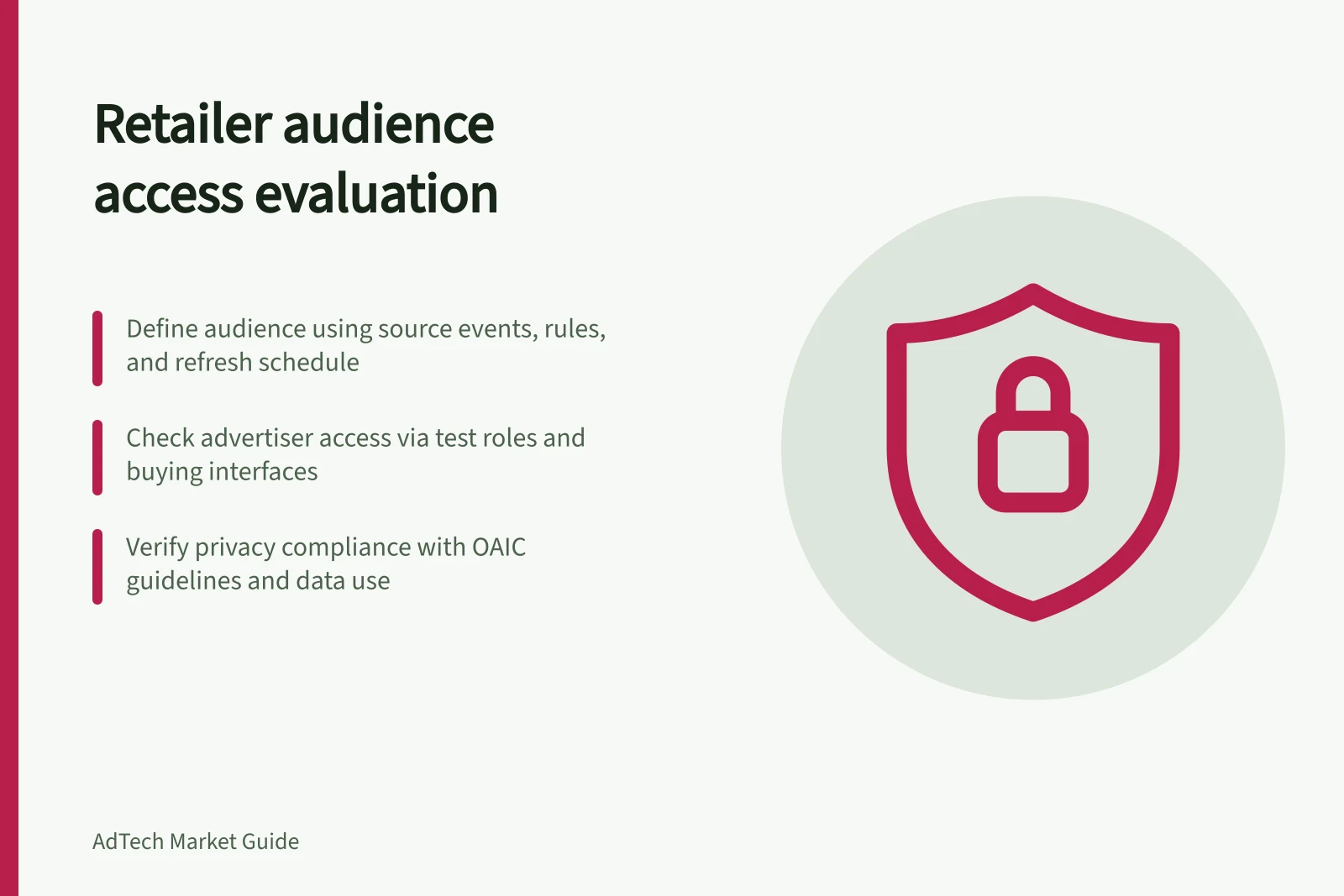
For each proposed segment, record source events, inclusion and exclusion rules, lookback period, identity unit and refresh schedule. Name the retailer owner, approved advertisers, destinations and reporting level. A label such as “recent category buyers” requires a defined category, purchase event and time period.
Keep three populations separate: records meeting the retailer’s rule, records technically usable at a destination, and shoppers who receive an ad. If one count is unavailable, mark it unavailable rather than using an audience estimate as a reach figure.
Inspect each buying interface
A media owner can assign advertiser-specific segments, while shared agency-template segments remain visible to all advertisers. A separate Console feature lets the owner expose a curated set of segments through campaign templates. That Console flow currently supports inclusion; Kevel describes exclusion and bid modification there as future additions, although its ad server has broader segment-targeting functions.
Criteo Commerce Yield describes retailer control over access to first-party data and inventory. Its documented offsite offering uses retailer audiences across the open internet and requires OneTag. Microsoft Retail Media describes offsite use of retailer first-party data.
Review privacy along the actual route
For Australian operations, have the privacy owner assess how the audience is constructed, sent and used. The OAIC publishes guidance titled “Tracking pixels and privacy obligations”. Assess applicable privacy requirements, including any relevant direct-marketing obligations, against the retailer’s actual data and use.
Ask whether an advertiser sees a segment label and aggregate report, may build a segment from approved inputs, or can receive underlying records. Specify partner reuse, expiry and the effect of a changed shopper choice. The phrase “first-party data” does not answer those questions.
Privacy and data handling considerations for Australian retailers
- Relevant regulator
- Office of the Australian Information Commissioner (OAIC)
- Key obligation
- Compliance with tracking pixel and privacy obligations under Australian Privacy Principles (APPs)
- Data subject right
- Shopper choice must be respected; changes affect data reuse and expiry
Check access before offering the segment
Run an account check: create a permitted test segment and two advertiser roles. Record what each role can discover, select, edit and export. Include an agency role and offsite destination if the proposed program uses them. Then check how revoked access or a changed segment definition affects active campaigns.
Offer the audience through a buying route when its definition, purpose, buyer permissions, destination and observable delivery limits are documented together. Keep an unresolved route unavailable until its owner can establish the relevant control.