Verification
Reviewing retailer measurement data flows
Trace retail ad events to sales reports, check attribution settings and distinguish credited sales from incremental effects.
Review a retailer advertising report by tracing a credited sale back to its sale record, product relationship, eligible ad interaction and campaign attribution rule. Keep delivery, attributed sales and incremental sales separate. A matched exposure and purchase can support attribution under a stated rule; it does not by itself show that advertising caused the purchase.
Identify the events and owners
For one campaign, identify who records the ad decision, impression, click, purchase, cancellation and return. State what one record represents and which identifiers connect records.
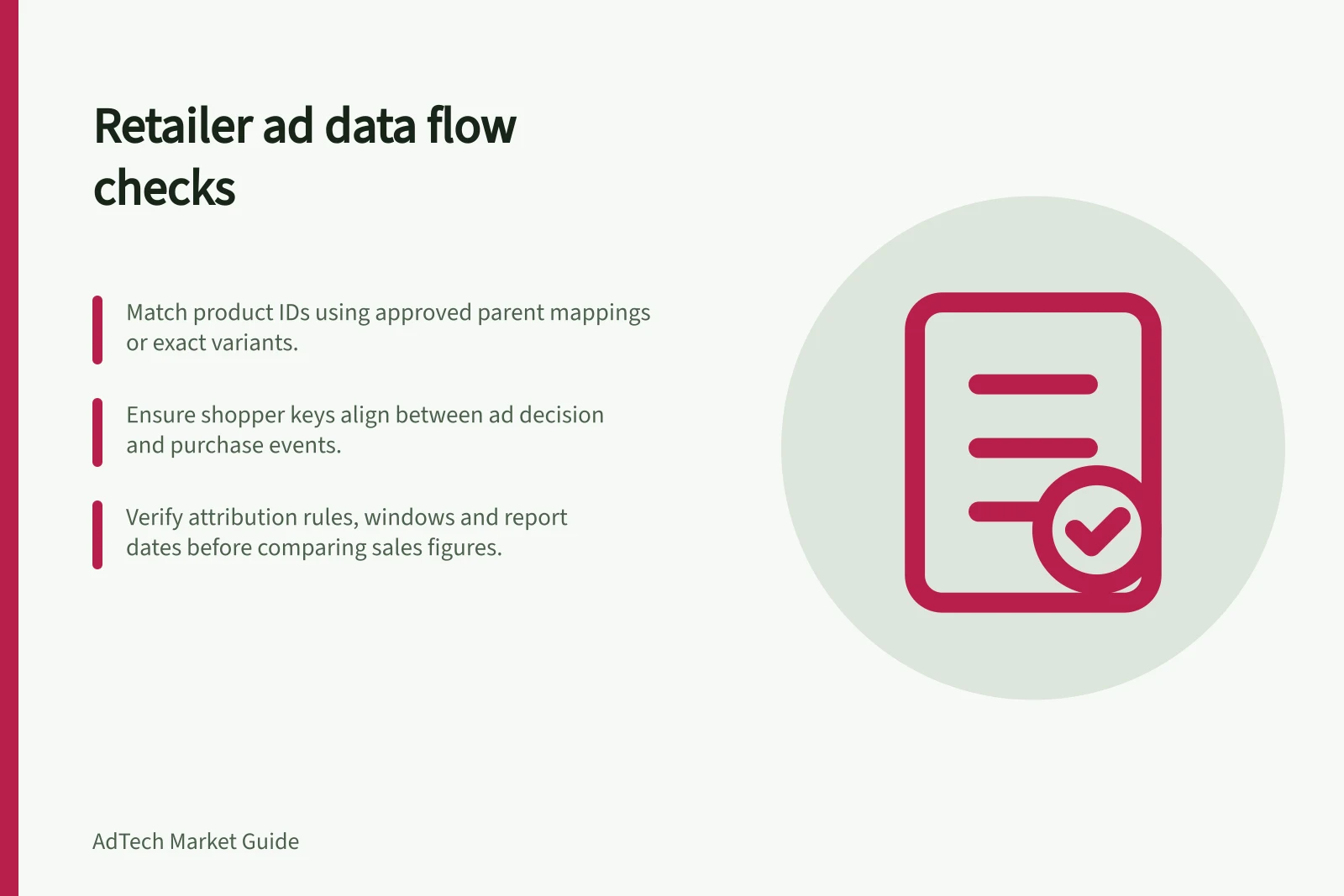
A product ID in the ad response must describe the same item, or have an approved parent mapping, when a purchase arrives. Shopper matching also requires a permitted, usable key at the relevant events.
Kevel illustrates these dependencies: its attribution setup uses Catalog, campaign settings, an ad interaction with a user key and a purchase event stream. Its FAQ says the user key must match between the decision request and sales feed. This is Kevel's model, not a universal event schema.
| Flow point | Question to resolve |
|---|---|
| Decision and delivery | Is the record an opportunity, returned ad or impression? |
| Engagement | What counts as a click? |
| Sale | Is the record an order, item, paid sale or settled sale? |
| Product match | Exact variant, parent, category, brand or seller? |
| Shopper match | Which permitted key joins events, and what remains unmatched? |
| Attribution | Which click or view receives credit, under which window? |
| Output | What can the advertiser see, export and reconcile? |
Read the rule beside the figure
Return on ad spend depends on the sales numerator and spend denominator. Check whether sales include refunds and cancellations, store purchases, only the promoted item or a broader product group. Keep post-click and post-view results separate where available.
Kevel documents last-touch attribution with configurable product matching and lookback windows. Criteo describes user, product and window matching and says edits to attribution settings can update its dashboards retrospectively.
Record the rule version and extraction date before comparing reports; a changed attributed-sales figure need not mean more products were sold.
Post-Click vs Post-View Attribution Results
- Attribution Type
- Post-Click
- Attribution Window
- Configurable (e.g., 7-day click window)
- Sales Inclusion
- Refunds excluded; only promoted item tracked
- Attribution Type
- Post-View
- Attribution Window
- Configurable (e.g., 14-day view window)
- Sales Inclusion
- Store purchases included; broader product group may be tracked
Reconcile where records leave the flow
A sale may be absent from attribution because its feed arrived late, an item or shopper key did not match, the window ended, or the sale fell outside the report population. A delivery event may be absent because the relevant tracking call did not arrive. These are investigation possibilities, not diagnoses.
Request available counts for the same campaign, placement and period at each stage. Separate missing keys, unmatched records, excluded products and late corrections where the provider's reporting permits. Align time zone, currency, order status, item scope and extraction time before comparing a dashboard with the retailer's ledger.
Reconciliation Checklist: Where Records Leave the Flow
- Late sale feed arrivalCheck if a sale was delayed beyond the attribution window.
- Mismatched shopper keyVerify if the shopper identifier did not match across events.
- Unmatched product IDConfirm product IDs are exact or mapped via approved parent relationship.
- Outside report populationEnsure the sale falls within the defined campaign, placement and time period.
- Missing tracking callConfirm delivery events were recorded by checking tracking call logs.
State the supported result
If no suitable comparison study was run, report attributed sales with their population and rules, without calling them lift. A proposed acceptance exercise uses authorised synthetic records for a matching sale, unmatched shopper, different product and late correction. Predict their treatment, then compare it with the available output.
Key Attribution Metrics and Their Definitions
- Attributed Sales
- Sales credited to an ad interaction under a specific rule
- Incremental Sales
- Sales that would not have occurred without the ad (requires controlled study)
- Delivery Events
- Impressions or ad responses delivered to users
- Matched Exposure-Purchase Pairs
- Validated link between ad exposure and purchase, but not proof of causation