Verification
Part of Connected TV advertising infrastructure
Checking measurement support in a CTV ad stack
Assess CTV delivery, playback, viewability, invalid traffic and reach reporting by signal source, coverage and unknown counts.
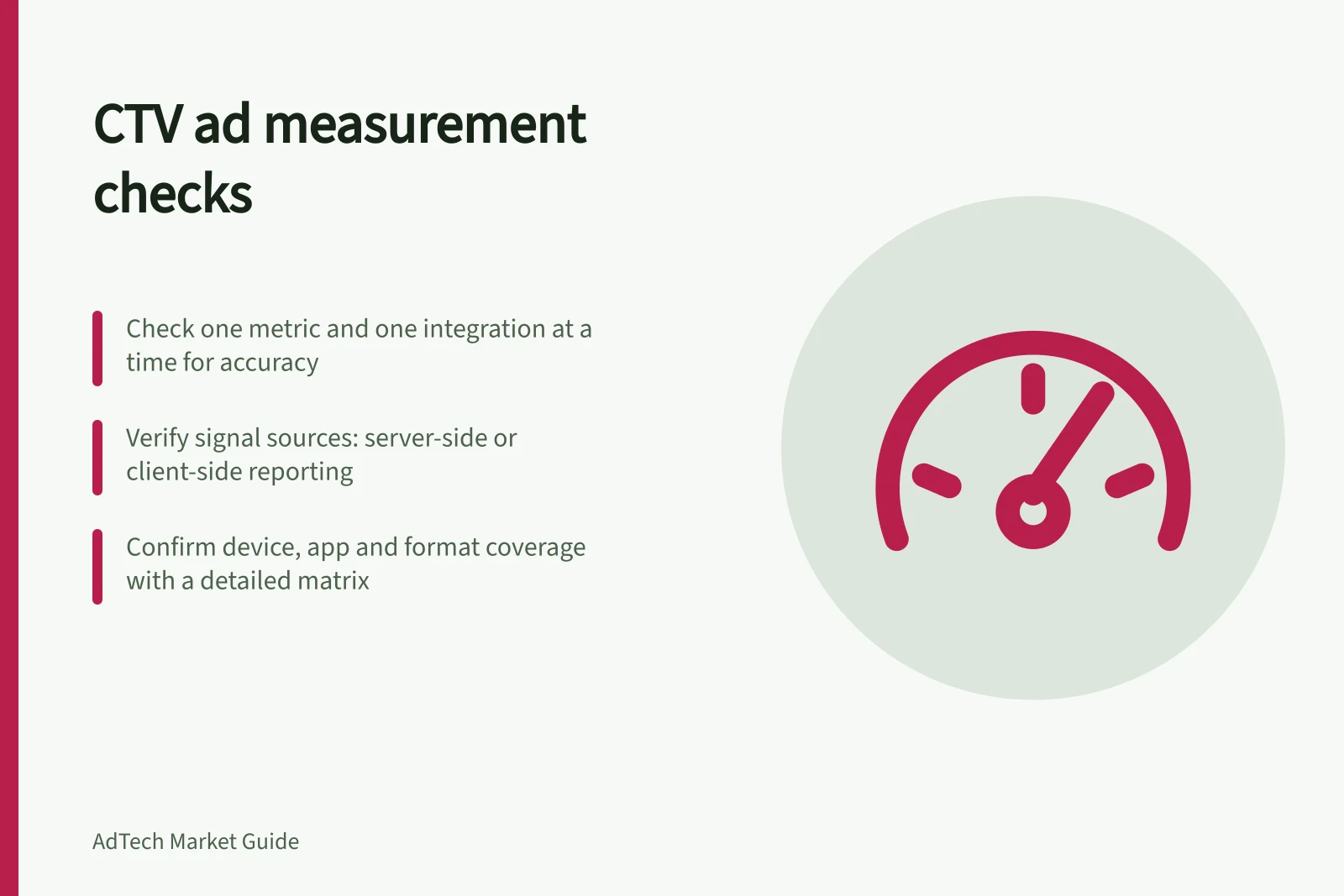
Check CTV measurement one metric and one integration at a time. An ad platform may log decisions or tracking events without the player signals needed to substantiate playback, viewability or independent verification on a particular device. Ask what each figure counts, who observed it and what share of planned inventory can be assessed.
Specify the report before assessing support
A delivery reconciliation needs a defined impression event and comparable counts. Frequency needs an identity unit and linked coverage.
Viewability and invalid-traffic assessment need appropriate signals and a way to report unknown results. An attributed outcome needs an exposure definition, outcome population and matching rule; a matched outcome does not establish causation.
| Requested measure | Support to verify | Limit to disclose |
|---|---|---|
| Delivery | Impression-counting rule and evidence of playback or a validated insertion method | An ad decision or prepared manifest is earlier than playback. |
| Playback progress | Origin of start, progress and completion events | A server event may be based on segment requests. |
| Viewability | Supported player and device signals, integration and method | Unmeasured delivery is not viewable delivery. |
| Invalid traffic | Detection and filtration scope, plus unknown counts | Proxy or data-centre routing alone is not invalidity. |
| Reach and frequency | Device, account, household or person unit and linked coverage | Unlinked impressions cannot simply be treated as deduplicated. |
The table is an acceptance template, not a promise that every provider supplies every measure.
Measurement Support Requirements Across CTV Metrics
- Delivery
- Impression-counting rule and evidence of playback or validated insertion method
- Playback progress
- Origin of start, progress and completion events
- Viewability
- Supported player and device signals, integration and method
- Invalid traffic
- Detection and filtration scope, plus unknown counts
- Reach and frequency
- Device, account, household or person unit and linked coverage
Inspect the signal path
Identify whether the app or player sends tracking, an insertion service sends it based on player requests, or both contribute different events. MediaTailor offers server-side reporting, where it sends tracking beacons directly to the ad server, and client-side reporting, where the player sends the beacons.
In Google's full-service DAI, the client SDK sends impression pings and tracking events as needed. Check the actual integration before applying either example to a proposed account.
For server-originated tracking, ask the measurer how it validates playback, which traffic meets its method and how it reports delivery that cannot be measured or classified for invalid traffic.
Check device and format coverage
Open Measurement provides common code and libraries for measurement across mobile apps, web and connected TV where the relevant SDK is integrated. This does not establish that the planned Australian app, player, device and verifier support a particular metric.
Request a matrix by app, operating system or device family, player, insertion mode, format and metric. For each combination, record whether the signal is directly observed, supplied through a validated integration or unavailable. Show measured and unknown counts alongside rates. If a partner cites accreditation, confirm its exact service, metric and environment.
CTV Measurement Signal Coverage by Device and Format
- Measured count
- Varies by app, OS, device family, player, insertion mode, format
- Unknown count
- Reported alongside measured counts per combination
- Coverage rate
- Calculated as measured ÷ (measured + unknown)
- Signal source
- Directly observed, validated integration, or unavailable
- Accreditation status
- Confirm exact service, metric and environment
Reconcile a sample report
Ask the publisher, insertion service, ad server and measurer for a sample covering the same dates, app and format. Align time zone, filtering and event definitions. Compare decisions with decisions and impressions with impressions; keep unlike stages separate.
Where authorised test data is available, examine a completed ad, an abandoned break and a case with missing player signals.
Accept a measurement claim only for the event definition, signal source, coverage and report route demonstrated for the actual inventory. Narrow any unsupported claim to the events the systems can substantiate.
Steps to Reconcile a Sample CTV Ad Report
- Request sample report from publisher, insertion service, ad server and measurerCover same dates, app and format
- Align time zone, filtering and event definitionsEnsure consistency across systems
- Compare decisions with decisions; impressions with impressionsKeep unlike stages separate
- Examine authorised test data: completed ad, abandoned break, missing player signalsValidate signal reliability
- Accept measurement claim only for demonstrated event definition, signal source, coverage and report routeNarrow unsupported claims to substantiated events