Supply Chain
Connected TV advertising infrastructure
Map a CTV ad stack from streaming break and bid request to insertion, playback and measurement, with practical checks for each handoff.
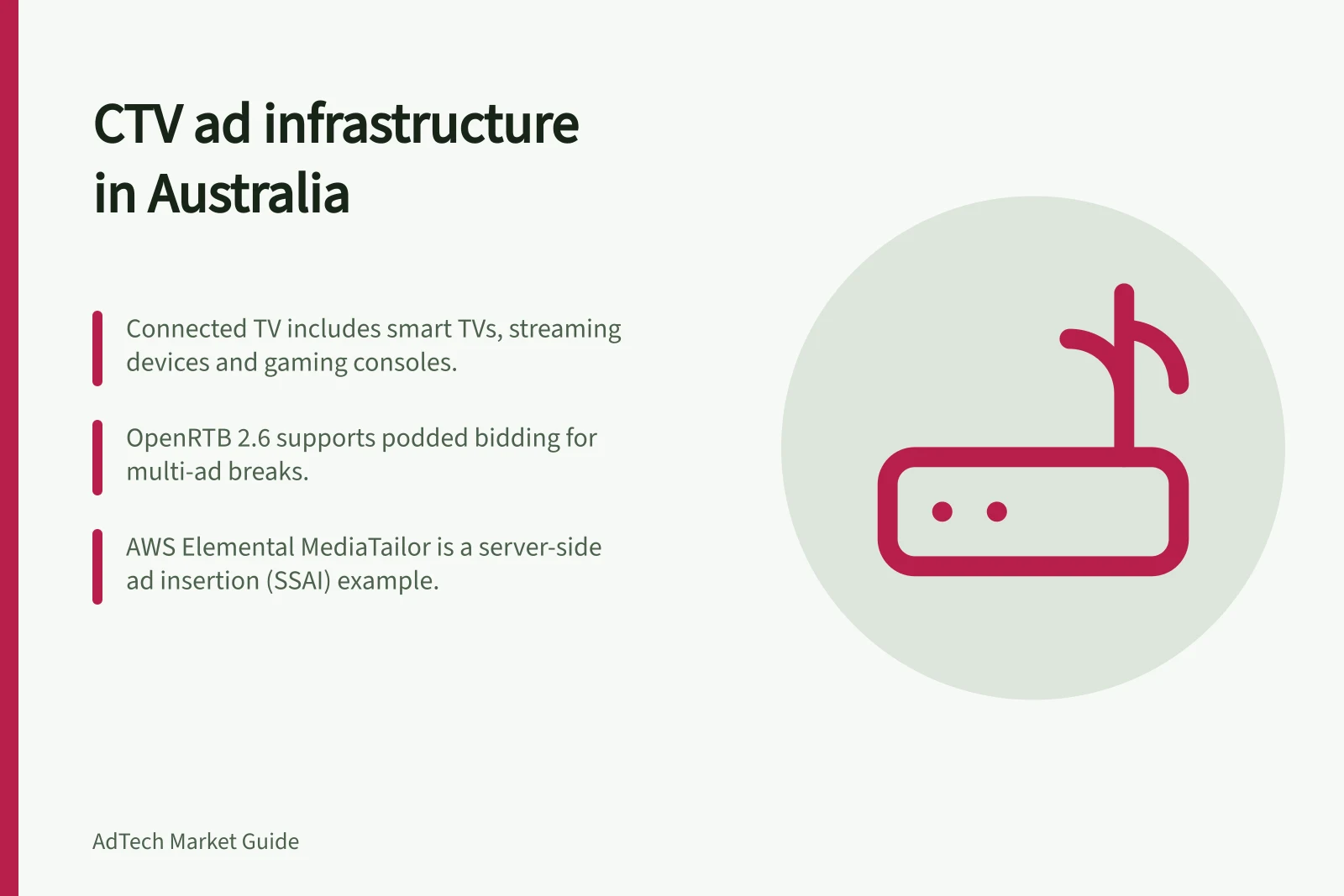
Connected TV (CTV) advertising infrastructure links a streaming app and player to break signalling, ad selection, a buying route, insertion, identity and measurement. In Australia, a connected television can be a television connected to the internet through built-in smart-TV capability, a streaming device or a gaming console. To assess a stack, follow one break through those handoffs. A bid request, a selected ad and a measured impression are distinct events.
Map the break
Record whether the stream is live or on demand, which app and player carry it, where the break is marked and who controls its duration. A break can contain several ad opportunities. OpenRTB 2.6 can describe slots within a pod, so several opportunities associated with one break do not automatically indicate duplicate traffic.
| Layer | Decision to identify | Evidence to request |
|---|---|---|
| App and player | Where can the ad play? | App, device family, player and content type |
| Break signalling | What marks the break and its duration? | Marker or schedule, timing and available break ID |
| Ad decision | Which ads are eligible for the break? | Decision route, response and unfilled reason |
| Buying route | Which buyers can receive an opportunity? | Deal or auction route and seller identifiers |
| Insertion | Who prepares and places the ad media? | Manifest or player integration and creative requirements |
| Measurement | What event does each party count? | Signal origin, definition, coverage and sample report |
A content manifest can mark an ad opportunity with SCTE-35. At the ad-decision handoff, VAST, VMAP and VPAID are named response formats; confirm which format the integration accepts.
One company may operate several layers. Confirm the configuration for the proposed Australian app and account: support for a standard does not establish that a particular device, deal or report field is enabled.
IAB Australia's Australian CTV Market: An Investigation into Growth, dated 25 November 2020, described premium broadcaster BVOD suppliers packaging products and audiences through direct deals rather than open-market bidding. The report includes comments from Jordan King, Director of Audience and Automation at Nine, and Nicole Bence, Network Digital Sales Director at Seven Network. Treat this as a historical route to ask about, not a guarantee of current availability; confirm the publisher, deal and account configuration.
Nine Now, SBS On Demand and Seven Plus are examples of broadcaster BVOD platforms. YouTube and Apple TV illustrate CTV's broader mix of streaming options.
Key Australian CTV Platforms and Market Insights
- Leading BVOD Platforms
- Nine Now, SBS On Demand, Seven Plus
- Global CTV Examples
- YouTube, Apple TV
- Market Growth Report
- IAB Australia, November 2020
Follow the ad into playback
In server-side ad insertion (SSAI), a service can prepare ad media and a personalised manifest before the player requests the ad segments. Other designs leave more of the switch into an ad pod to the device. Ask who supplies the break marker, handles an empty or unsuitable ad response, prepares compatible media and tells the player where each ad begins and ends.
Insertion is the handoff that turns an accepted ad response into media prepared for playback; SSAI and device-side insertion place that work in different parts of the stack. AWS Elemental MediaTailor is a named SSAI example; its event flow is a pointer for the detailed implementation handoff.
A successful ad decision does not prove playback. A manifest containing an ad shows that it was prepared for a session; a segment request and a player event provide different later evidence. The insertion model also affects who sends tracking events.
The IAB Tech Lab CTV Ad Portfolio Initiative identified six formats for standardisation: pause, menu, screensaver, overlay, in-scene insertion and squeeze-back ads. If a proposal uses one, confirm the publisher offers that format and what the integration accepts; a standardised format name alone does not establish support in the proposed app or on its devices.
A mezzanine file is raw high-resolution video that a publisher can use to render an asset for the screen resolutions on which it will run. Ask whether the buyer or publisher supplies it, and include the required asset and resolution expectations in the creative handoff.
Check the buying and supply signals
OpenRTB 2.6 Podded Bidding lets buyers bid on specific slots within a multi-ad break. A CTV bid request may carry information about the opportunity, but the details available depend on the integration. Check whether the proposed buyer receives enough context to assess the slot, duration and permitted creative.
For app inventory, ask which seller authorisation and supply-chain records are available, how the parties interpret them, and what they establish. Such records support a path check; they do not prove that traffic is genuine.
If two paths appear to sell the same break, determine whether they carry distinct slots, separate selling routes or repeated calls for one opportunity. That is a request-level investigation, separate from this stack map.
Give identity and measurement defined jobs
A device advertising ID, a signed-in account and a household graph identify different units. A shared TV or household link does not establish which resident watched. For targeting, frequency or reach, state whether the unit is a device, account, household or person, and show how unmatched impressions are treated. A matched audience count is not delivered reach.
For an Australian deployment, have the privacy owner assess the actual identifiers, purposes and recipients. Apple requires App Tracking Transparency permission for covered tracking or advertising-ID access on tvOS 14.5 or later; that is a platform-specific rule, not a description of every CTV device.
Request separate definitions for decisions, delivered impressions, playback progress, viewability, invalid-traffic treatment and deduplicated reach. A server can send tracking based on segment requests without directly observing the player's rendered state. Open Measurement can provide player and device signals where a supported integration is in place, but support must be checked for the actual app, player, device and metric.
A tracking beacon can report impressions, quartiles and completion to the ad server or another measurement system. In server-side reporting, it may be fired based on player segment requests; in client-side reporting, the playback device fires URLs supplied in the personalised manifest.
Before committing to a proposed stack, request a configuration walkthrough and sample report for the exact route. Trace the break marker, slot decisions, insertion result, tracking origin and unknown measurement population. Assign an owner to each handoff.
Apple requires developers to provide information about app privacy practices in App Store Connect when submitting new apps and app updates. For third-party code such as advertising or analytics SDKs, privacy manifests describe the data collected, how it is used and whether it tracks users; Xcode combines the manifests when preparing distribution.
Open Measurement SDK is intended to standardise signals such as whether an ad appeared on screen, the percentage in view and how long it remained there. It can also facilitate third-party verification of invalid traffic and brand requirements. Integrated apps and sites send signals through the Open Measurement Interface Definition, where measurement-provider tags can collect them; confirm which signals the proposed integration exposes.
Pre-Deployment Stack Validation Checklist for Australian CTV
- Confirm device advertising ID supportCheck if Apple’s App Tracking Transparency applies (tvOS 14.5+)
- Verify identity unit definitionClarify whether targeting uses device, account, household, or person-level data
- Assess Open Measurement SDK integrationConfirm supported signals (viewability, in-view percentage, brand safety)
- Review privacy manifestsEnsure App Store Connect includes data use disclosures for third-party SDKs
- Request sample reportTrace break marker, slot decisions, insertion result, tracking origin, and unknown measurement population
In this guide
- Understanding server-side ad insertion in streamingFollow an SSAI ad break from marker and ad decision to manifest, playback and beacons, with the key integration questions to ask.
- Investigating duplicate ad requests in streaming inventoryDistinguish repeated CTV ad calls from pod slots, parallel supply routes, segment retries and duplicate beacons using an event trail.
- Checking measurement support in a CTV ad stackAssess CTV delivery, playback, viewability, invalid traffic and reach reporting by signal source, coverage and unknown counts.