Supply Chain
Advertising clean rooms
Understand what advertising clean rooms can support, which controls to inspect and how to interpret matched campaign results.
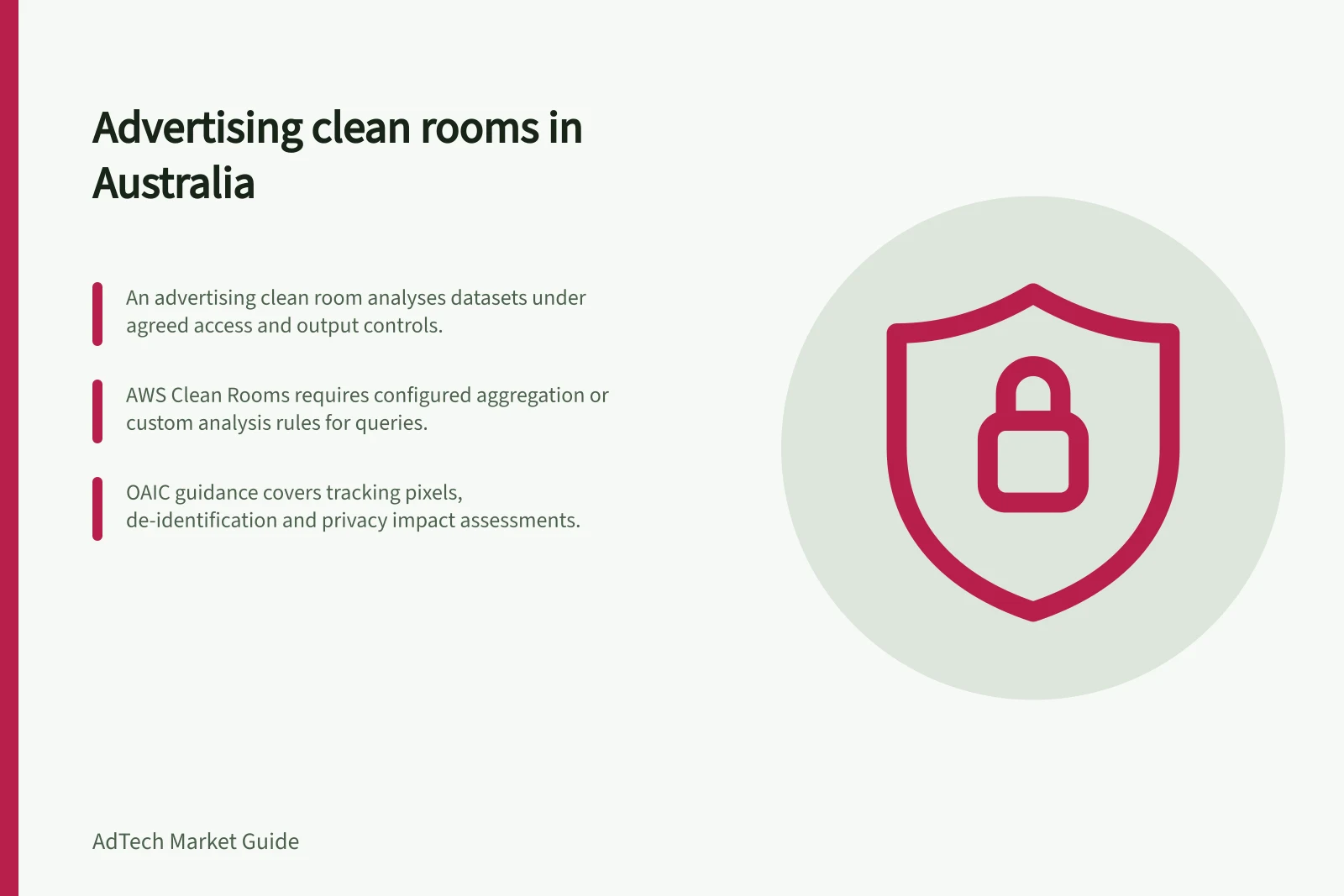
An advertising clean room lets organisations analyse related datasets under agreed access and output controls. It may help answer an audience-overlap or campaign-measurement question without giving every participant unrestricted access to the others' source records.
Start with the decision the result must support. A clean room does not automatically make a data use lawful, a match accurate or a sale incremental.
Start with the question
An advertiser and a publisher might ask how many eligible customers had a campaign exposure recorded. They need an agreed definition of a customer and an exposure, a usable join key, and permission to return the result.
For audience overlap, establish which records could match and what a match represents. For exposure and outcome reporting, agree which events and dates are included.
For activation, specify who may receive the audience and which fields may leave the collaboration. For incremental effect, identify a comparison that estimates outcomes that would have occurred without the campaign.
A match count is not the same as delivered reach. Joining an exposure to a later purchase does not by itself show that the ad caused the purchase.
Key Steps to Implementing an Advertising Clean Room in Australia
- Define the business questione.g., audience overlap, campaign exposure, incremental lift
- Establish agreed definitionscustomer, exposure, purchase event, time zone, duplicate handling
- Confirm data inputs and join keysEnsure compatibility of identifier formats (e.g., hashed IDs) and privacy-safe matching
- Apply privacy controlsSet aggregation thresholds, enable noise injection, restrict user-level exports
- Review OAIC guidance for complianceCheck de-identification practices, tracking pixels, and privacy impact assessments
- Assign collaboration rolesDefine owner, data provider, analysis runner, result recipient
Inspect the proposed controls
AWS Clean Rooms lets data owners configure aggregation, list or custom analysis rules on tables. Queries involving several configured tables must satisfy the more restrictive applicable controls.
A custom rule may allow reviewed templates or queries from authorised accounts. A minimum aggregation threshold is an available control, not a universal guarantee.
Snowflake Data Clean Rooms uses data offerings, permitted analyses and policies. A provider specifies which columns are available, and free-form SQL requires an offering that enables it and remains subject to applicable source and offering policies.
Google Ads Data Hub applies privacy checks that can filter results. Published capabilities do not establish what a particular account or collaboration has enabled.
Ask for the proposed inputs, join columns, permitted queries, output fields and recipients. A group-size threshold alone does not control every way a query might narrow a result.
Privacy checks shape what is observable
Ads Data Hub checks query statements for concerns such as exporting user identifiers or functions of identifiers, and using blocked functions on fields containing user-level data. It also limits repeated access to a given piece of data, checks aggregation size, and compares results with previous jobs and rows within a result set; changes in underlying data between jobs can trigger a difference violation.
Noise injection is an alternative to difference checks. It adds random noise to an aggregating SELECT clause to protect privacy while aiming for reasonable accuracy, and can reduce the required aggregation threshold for an output.
When a result fails privacy checks, Ads Data Hub may report that a row or the whole result set was filtered. A filtered-row summary may explain dropped rows, but can be withheld when it would not meet aggregation requirements.
Prepare the agreement and data together
For each input, name its owner, purpose, permitted use and row meaning. Record the identifier format, time zone, dates, duplicate treatment and outcome definition.
Agree who can approve queries, receive results or request activation, and how corrections and withdrawn choices will be handled. Keep these decisions with the collaboration agreement and the result specification.
For an Australian project, the privacy owner should assess the actual data flow, including any tracking-pixel use, against applicable privacy obligations. The OAIC (Office of the Australian Information Commissioner) has guidance titled Tracking pixels and privacy obligations, and lists resources titled De-identification and the Privacy Act, Guidelines on data matching in Australian Government administration, and 10 steps to undertaking a privacy impact assessment.
Check relevant OAIC guidance against the project's actual data flow. The titles alone do not settle whether a particular collection, match or activation is appropriate.
Assign collaboration roles deliberately
A collaboration can separate ownership, data provision and analysis. In Snowflake Data Clean Rooms, the owner creates and owns the collaboration, invites participants and assigns roles; a collaboration has one owner.
Ownership does not automatically grant permission to provide data or run analysis. A data provider supplies offerings and specifies which analysis runners may use them, while an analysis runner runs permitted templates on permitted offerings.
A participant may hold more than one role. Confirm who is responsible for each task before the collaboration begins, including who can make data available, who can run an analysis and who can receive or activate its results.
Read the result within its limits
A returned figure describes eligible, joinable records that the configured rules allowed into the output. Other records may be unmatched, unobserved or suppressed.
Keep the input population, matching unit, dates, exclusions and metric definition beside the figure. Mark an unavailable breakdown as unknown rather than zero.
For a first project, choose one bounded question and agree on a sample result specification before expanding access. If the decision requires a lift claim, plan a suitable comparison study as well as the clean-room analysis.
In this guide
- What a clean room can and cannot revealSee what clean-room outputs establish, how disclosure controls differ and which populations remain unknown.
- Preparing datasets for a clean room projectDefine clean-room table grain, match keys, eligibility, duplicates and output requirements before loading data.
- Evaluating clean room results without overstating causationSeparate matched and attributed outcomes from incremental effects by checking populations, comparison design and uncertainty.