Supply Chain
Part of Supply-path transparency
Comparing direct and indirect inventory access
Compare direct and indirect access to the same publisher inventory by checking what each route actually offers.
Compare actual route types to the same publisher inventory, not abstract labels. A direct route may be a publisher-negotiated Programmatic Guaranteed deal or Preferred Deal; indirect access may be through a Private Marketplace (PMP), an open auction, an SSP, an exchange or a reseller. Treat route labels as clues, not rankings of media quality or a complete account of commercial cost.
Establish that the inventory is comparable
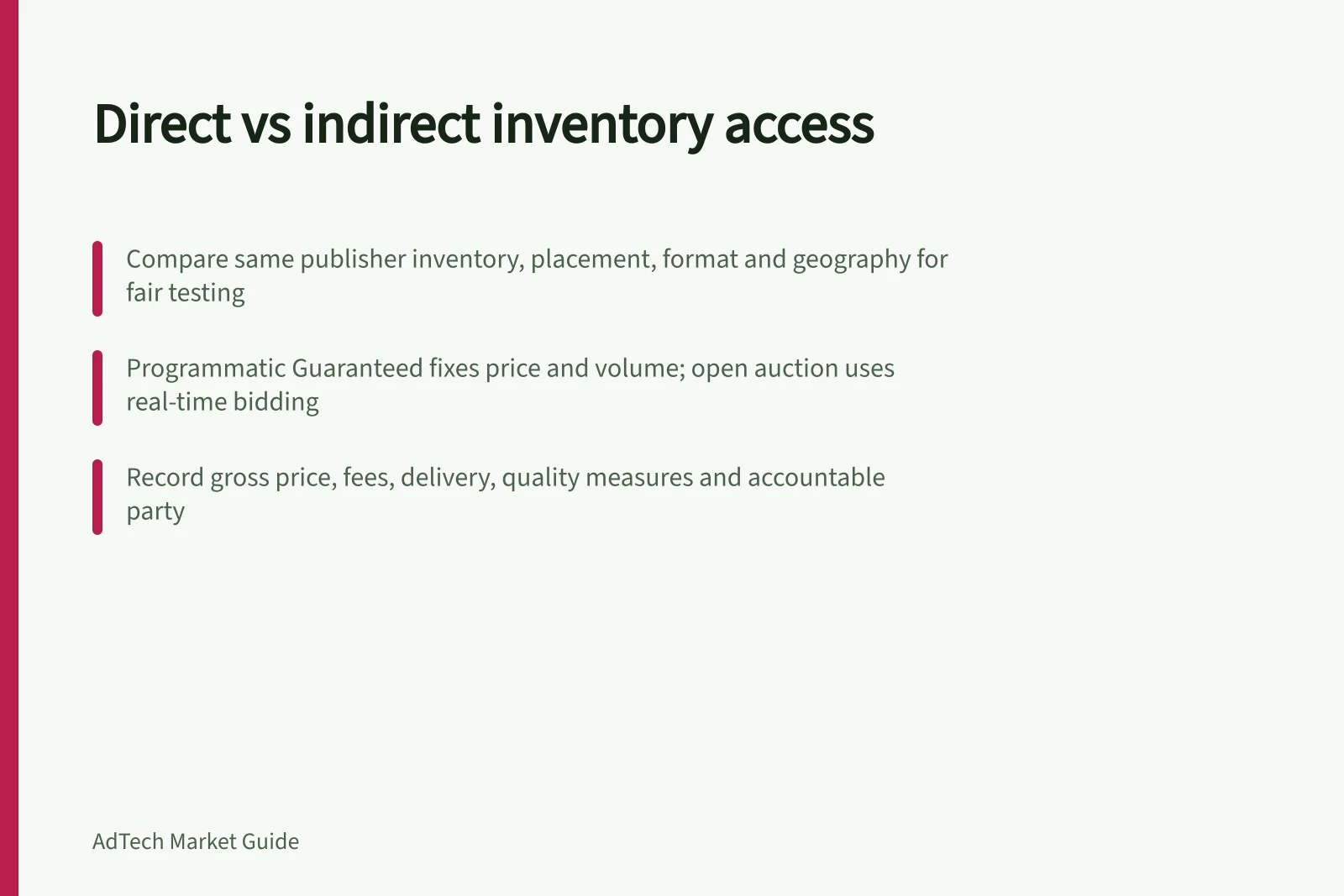
Match the publisher or app, placement, format, geography, device, audience conditions and period. A publisher-negotiated Programmatic Guaranteed deal or Preferred Deal may not carry every format or opportunity a reseller offers. If available impressions differ, a simple CPM or performance comparison confounds the route with the inventory mix; ask partners for reporting that supports a like-for-like view.
For example, compare a publisher-negotiated Programmatic Guaranteed deal with an open-auction bid for the same placement offered through the publisher’s SSP and an exchange. If a reseller also sells that inventory, record it as another selling party. Programmatic Guaranteed fixes price and volume contractually, while open-auction prices are set through real-time bidding and the highest bid wins.
Use the same fill-in record for both routes: publisher or app, placement, format, geography, device, audience, period, route type, selling parties, gross price, fees, delivery, quality measures, discrepancy rate, support and accountable party. Before a test, also set its window, outcome, minimum useful sample and minimum detectable difference; choose campaign-specific values rather than assuming a universal figure.
For checks of ads.txt or app-ads.txt declarations and seller IDs in sellers.json, use the separate guide “Reading ads.txt and sellers.json together”. Where available, compare SupplyChain nodes on sample bid requests; each node represents an entity in the transaction and includes an advertising system identifier and seller ID. The complete flag indicates whether the chain includes all nodes back to the inventory owner, so an incomplete chain cannot prove that earlier sellers are absent.
Compare the trade-offs
A PMP or private auction restricts participation to selected advertisers; the publisher or exchange may set a floor, and the highest bid wins. A Preferred Deal is one-to-one negotiated fixed-price access to unreserved inventory with first look. Compare these with Programmatic Guaranteed, where impression volume and price are contractually fixed, and with open-auction access.
Record the gross price you pay, any disclosed fees, delivery, auction access, quality measures, discrepancy rates and operational support. Compare the actual terms and campaign results rather than relying on assumed fee or discrepancy benchmarks.
Ask which party—the publisher, SSP, exchange or reseller—is accountable for a blocked creative, a measurement difference or an invalid inventory claim. An indirect route may add a service the direct route lacks; a direct route may simplify reconciliation. Neither outcome is guaranteed by the route label.
Use a controlled test if the decision warrants it. Hold targeting and creative as steady as possible, separate the routes in reporting, and watch for overlap or self-competition. Specify the outcome and minimum useful sample in advance, along with the test window and minimum detectable difference.
A small observed difference could be noise or reflect different inventory. Do not claim an uplift or saving until actual campaign data supports it.
Decide and review
Keep routes that have an understandable role and acceptable results under your policy. If both supply the same opportunity, decide whether to consolidate, retain redundancy or allocate by format. Record the publisher, seller IDs, reason for each route and review date.
Recheck after a partner changes its setup; a decision about last quarter’s path should not silently govern a new one.