Supply Chain
Supply-path transparency
Use ads.txt, sellers.json and SupplyChain data to understand who sells an ad opportunity and investigate uncertain routes.
Supply-path transparency helps a buyer understand which organisations are involved in selling a programmatic ad opportunity, and whether the route matches the publisher's declared relationships. A declared path is evidence to check, not proof that an impression is genuine or that the shortest route is automatically best.
Read three signals together
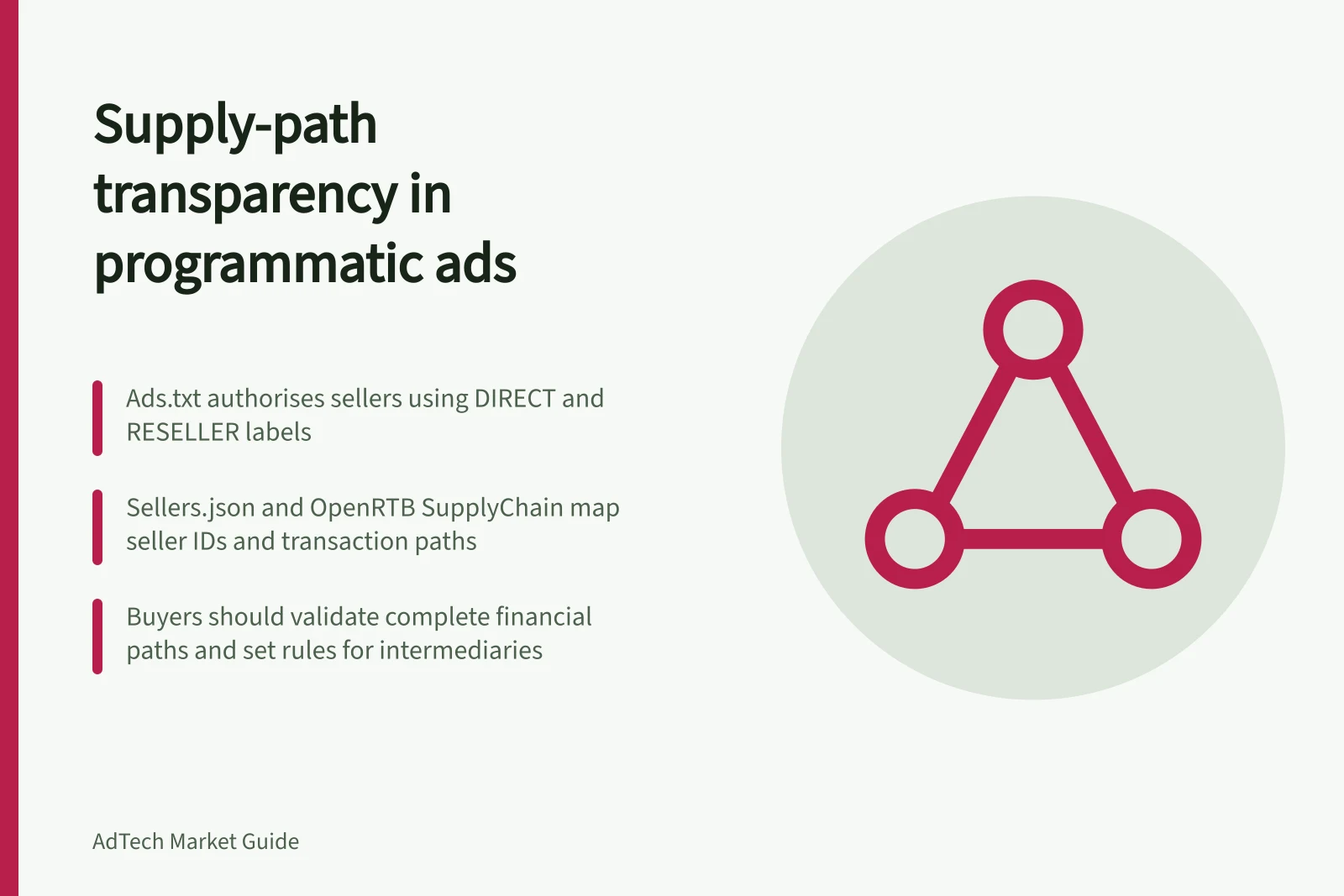
Ads.txt allows publisher content distributors and app publishers to define who is authorised to sell a given set of impressions via a bid request. Its DIRECT and RESELLER labels are distinct, and IAB Tech Lab notes that the distinction matters when a reseller claims a direct relationship.
Ads.txt does not attempt to reveal or authorise all parties involved in transacting those impressions, so it does not identify every intermediary in a particular bid request.
An advertising system's sellers.json file maps its seller IDs to entities, including publishers and intermediaries. The OpenRTB SupplyChain object, often called schain, travels with a bid request and lists nodes in the transaction path.
IAB Tech Lab describes these as complementary standards: authorisation, seller identity and the path for a given request. Compare their identifiers; do not treat similar company names as a match without the account ID.
Comparing Supply-Chain Signals: Ads.txt, Sellers.json and SupplyChain Object
- Purpose
- Authorise sellers for specific inventory (direct/reseller)
- Scope
- Maps seller IDs to entities (publishers, intermediaries)
- Function
- Lists nodes in the transaction path with financial flow visibility
Ask what each route adds
A publisher may sell through a directly controlled account and through authorised resellers. A reseller is not inherently unauthorised or poor quality. It may provide demand access, format support or operational service.
Ask which entity brings that value, which handles payment, and what each hop changes in cost, visibility or control. A chain of nodes can contain more than one seller.
Map the path before judging it: publisher or app, first selling system, any subsequent seller, and the system that sent the bid request to the buyer. The complete flag in a SupplyChain object states whether the chain contains all nodes back to the inventory owner.
If it is incomplete, do not infer the missing early links; record the gap instead.
Compare supply at the same level
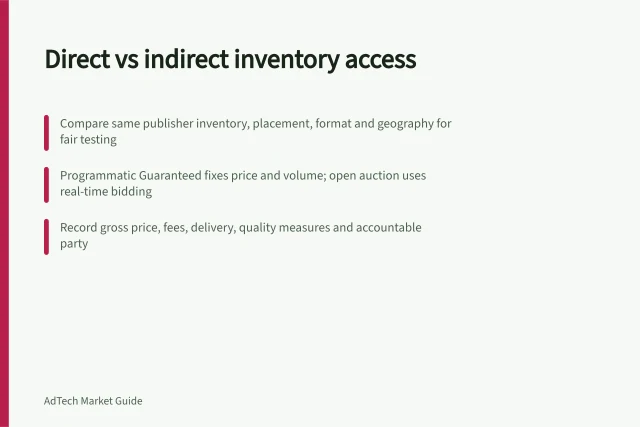
When two routes appear to reach the same inventory, compare them on the same publisher, format, geography, placement and period. Look at delivery, viewability or quality measures available to you, discrepancies and the service each partner provides.
Any outcome difference needs investigation; it is not caused by the number of hops merely because the routes differ. Check whether direct and indirect routes really cover the same opportunities before shifting budget.
Set a review rule for unexpected intermediaries. Reconcile the asi and sid in each SupplyChain node to the relevant sellers.json record, check ads.txt authorisation where applicable and ask the publisher or supply partner to explain a mismatch.
Know what transparency can establish
The SupplyChain object's nodes represent entities in the direct flow of payment for inventory. That gives buyers a view of who participates financially in a transaction, but the specification says future versions may also include entities involved in the transaction without handling payment.
The standards provide information for a decision, rather than a standalone measure of impression quality or a guarantee that inventory is valid.
Implementation also depends on the OpenRTB version in use: the SupplyChain object can be used with OpenRTB 2.5 and was officially added to the source object in OpenRTB 2.6 and 3.0. A buyer assessing coverage can therefore ask which version and implementation a partner supports.
Supply-Chain Standards and Implementation Status
- OpenRTB Version SupportAvailable from OpenRTB 2.5; officially part of source object in 2.6 and 3.0
- IAB Tech Lab AdoptionSellers.json and SupplyChain object ready for industry adoption
- Australian Tax Compliance DataATO provides publicly available data for tax compliance analysis
Set decision rules before reviewing paths
Decide in advance what findings should change a buying decision. IAB Tech Lab gives examples including validating a complete financial path against corresponding ads.txt entries, blocking impressions that pass through intermediaries the buyer considers untrustworthy, and prioritising preferred paths through supply-path optimisation.
A rule about untrustworthy intermediaries needs a stated basis beyond the path data itself. IAB Tech Lab cites out-of-band evidence such as a lack of TAG certification or a poor previous experience; recording the basis makes the decision more accountable than treating an unfamiliar name as sufficient evidence.
Buyers can also set a maximum number of intermediaries and block impressions that exceed it. The threshold is at the buyer's or platform's discretion, so it should reflect the buyer's own policy rather than being presented as a universal standard.
Apply these rules to individual impressions or defined buying conditions where the available data permits. IAB Tech Lab describes impression-level business decisions as one use of the combined signals.
Turn visibility into a decision
Maintain an approved path inventory with the publisher, partner, account IDs, route purpose and review date. Revisit it when a partner changes, a domain is added or a report shows a new seller.
In this guide
- Reading ads.txt and sellers.json togetherRead ads.txt and sellers.json together to connect a publisher's authorisation with the identity behind a seller account.
- Identifying resellers in an advertising supply pathIdentify a reseller by following the account and payment relationships in the path, not by assuming that any unfamiliar company is suspicious.
- Comparing direct and indirect inventory accessCompare direct and indirect access to the same publisher inventory by checking what each route actually offers.
- Investigating unexplained intermediaries in an ad reportAn unfamiliar intermediary in an ad report is a reason to reconcile the supply path, not a conclusion that fraud occurred.