Verification
Part of Understanding the advertising technology supply chain
Distinguishing media costs from technology fees
Separate media cost, platform and service fees, agency charges and seller revenue without double-counting reported totals.
Media cost, platform fees and the buyer’s total charge answer separate questions. Platforms and contracts may define “Media Cost” and “Total Media Cost” differently. Read the metric definition and fee schedule before treating a dashboard’s “spend” figure as payment for impressions alone.
Separate the amounts
| Amount | What to check |
|---|---|
| Media cost | What purchase does the figure cover, and which sell-side deductions, if any, are already reflected? |
| Buying-platform fee | Is it already included in a reported total, and what base does the contract use? |
| Data, verification and ad-serving fees | Which services generated them, and where are they reported or invoiced? |
| Agency or partner charge | Is it a separate charge or a markup within the client-facing figure? |
| Seller gross revenue | Which seller and inventory does the report cover? Is publisher revenue separately available? |
A fee schedule or invoice may list platform use, add-on services, third-party services, surcharges or taxes. Check the relevant documents to see which charges apply, how each is calculated and whether a rate is set contractually.
Check whether a reported total already includes any listed fees before adding them; otherwise, the same charge could be counted twice. An agency’s own markup may appear in its client-facing price without appearing on a platform invoice.
Media Cost vs. Technology Fees: Key Differences in Digital Advertising Spend
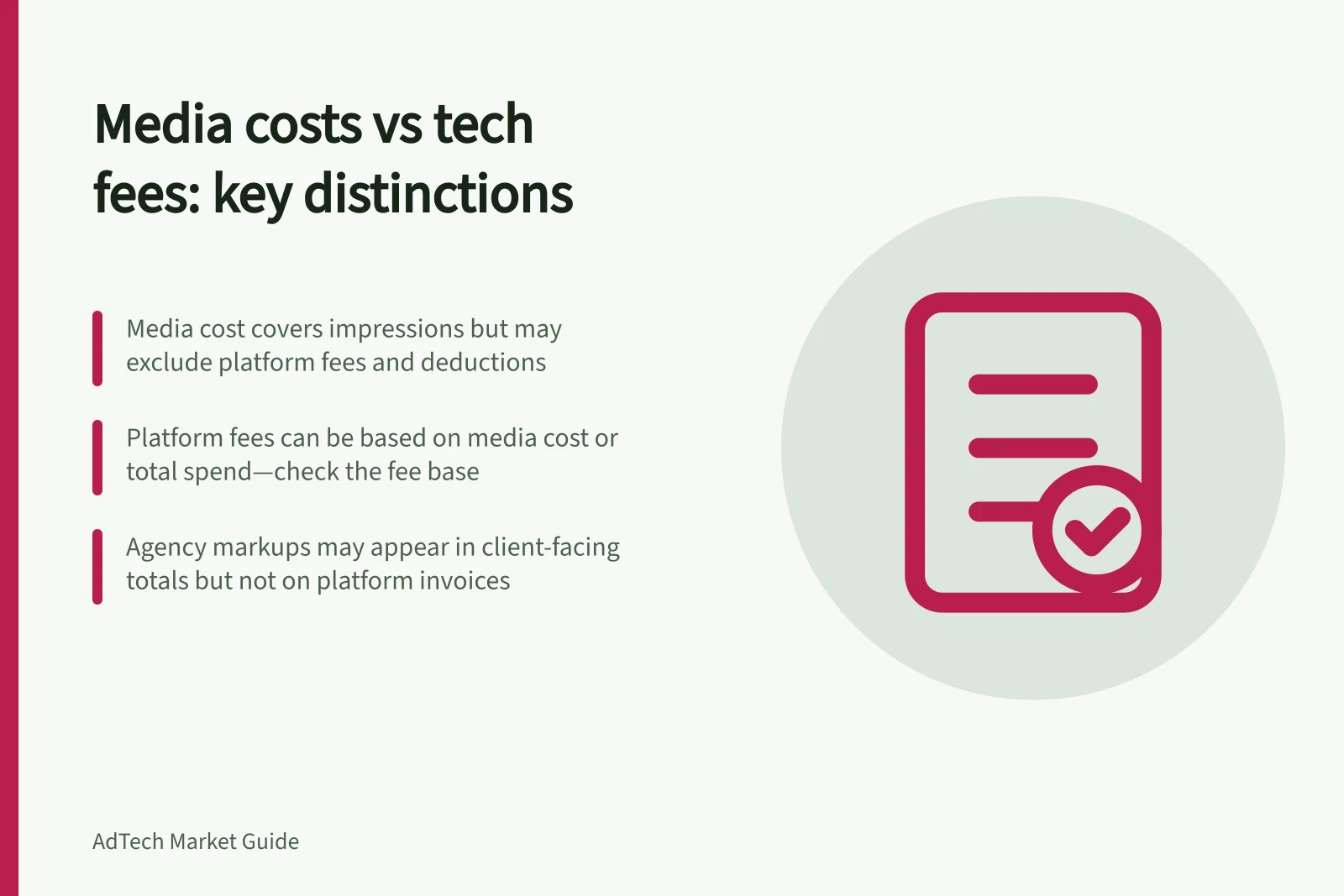
- Media CostPayment for impressions or ad placements; may include sell-side deductions.
- Buying-Platform FeeFee charged by the platform (e.g., Google Display & Video 360) based on media cost or total spend.
- Data, Verification & Ad-Serving FeesThird-party services for fraud detection, viewability, and ad delivery; often billed separately.
- Agency or Partner ChargeMarkup or fee added by an agency; may be embedded in client-facing pricing without appearing on platform invoices.
- Seller Gross RevenueTotal revenue reported by the seller; does not necessarily reflect publisher net receipts.
Check the fee base
A 10% fee on media cost differs from a 10% fee on the buyer’s total. A charge per thousand impressions uses a different denominator. For each fee, ask for its base, rate, billable event and currency, then check whether another reported amount already includes it.
For a purely hypothetical AUD calculation, suppose an invoice has AUD 1,000 media cost, an additional AUD 100 platform fee and an additional AUD 30 data fee. Those items total AUD 1,130.
If an agency separately charges AUD 80, its client-facing amount would be AUD 1,210 before any other applicable items. These figures illustrate arithmetic, not typical prices. They cannot establish publisher revenue without comparable sell-side reporting.
A report’s “revenue” field may refer to a buyer-facing or client-facing amount rather than publisher revenue. Check the metric definition and reporting context before using it in a seller comparison.
Reconcile comparable reports
Start with the buyer’s defined media cost, disclosed fees and buyer-facing total for the same campaign and period. For a seller comparison, obtain the corresponding seller gross-revenue report. Align currency, time zone, date range, inventory and seller identifiers before examining a gap. Do not assume that seller gross revenue equals the publisher’s net receipts when an intermediary is the reporting seller.
Check what each buyer and seller report covers, including its available dimensions, date range and metric definitions. Use comparable reporting fields and periods where possible, and note any limitations that prevent a like-for-like comparison.
Invalid traffic and different impression-counting methods can also produce discrepancies. A gap therefore needs investigation; it is not, by itself, evidence of an undisclosed fee.
A useful fee schedule names the charging party, service, calculation base and reporting location for each item. Mark any unavailable component as unavailable instead of assigning an unexplained difference to a particular platform.