Supply Chain
Part of Connected TV advertising infrastructure
Understanding server-side ad insertion in streaming
Follow an SSAI ad break from marker and ad decision to manifest, playback and beacons, with the key integration questions to ask.
Server-side ad insertion (SSAI) prepares advertising within a stream or its manifest before playback. A service detects a break, obtains an ad decision, prepares compatible media and gives the player a way to play it. Work division varies, especially for playback tracking.
Trace one break
A live or on-demand stream exposes an ad opportunity. In one documented SSAI design, the insertion service calls an ad decision server with break details, receives creative and tracking information, prepares the media and returns a personalised manifest. The player later requests segments.
A break marker shows an opportunity; an ad response shows a decision; a manifest shows preparation. None alone proves that the ad played.
| Handoff | Question to settle |
|---|---|
| Break signal | Who supplies its start, duration and available identity? |
| Ad decision | Who calls the ad server, and what session or break data is passed? |
| Media preparation | Who checks format and duration and prepares segments? |
| Player | How does it identify the ad and its playback milestones? |
| Tracking | Which system sends each impression and progress event? |
Specify what happens when an ad is missing, incompatible or longer than the available break. The fallback belongs to the actual integration; no single rule applies to every streaming service.
End-to-end SSAI ad break process in streaming
- Break marker
- Stream exposes ad opportunity; signal originates from content provider or CDN
- Ad decision request
- Insertion service calls ad decision server with break details (e.g., duration, ID)
- Ad response received
- Ad server returns creative assets, tracking URLs, and playback metadata
- Media preparation
- SSAI service stitches ad into stream or generates personalised manifest
- Player requests segments
- Client player fetches segmented media (e.g., HLS/DASH chunks) from origin or edge
- Playback and tracking
- Player renders ad; beacons sent via server-side or client-side reporting
Identify the insertion model
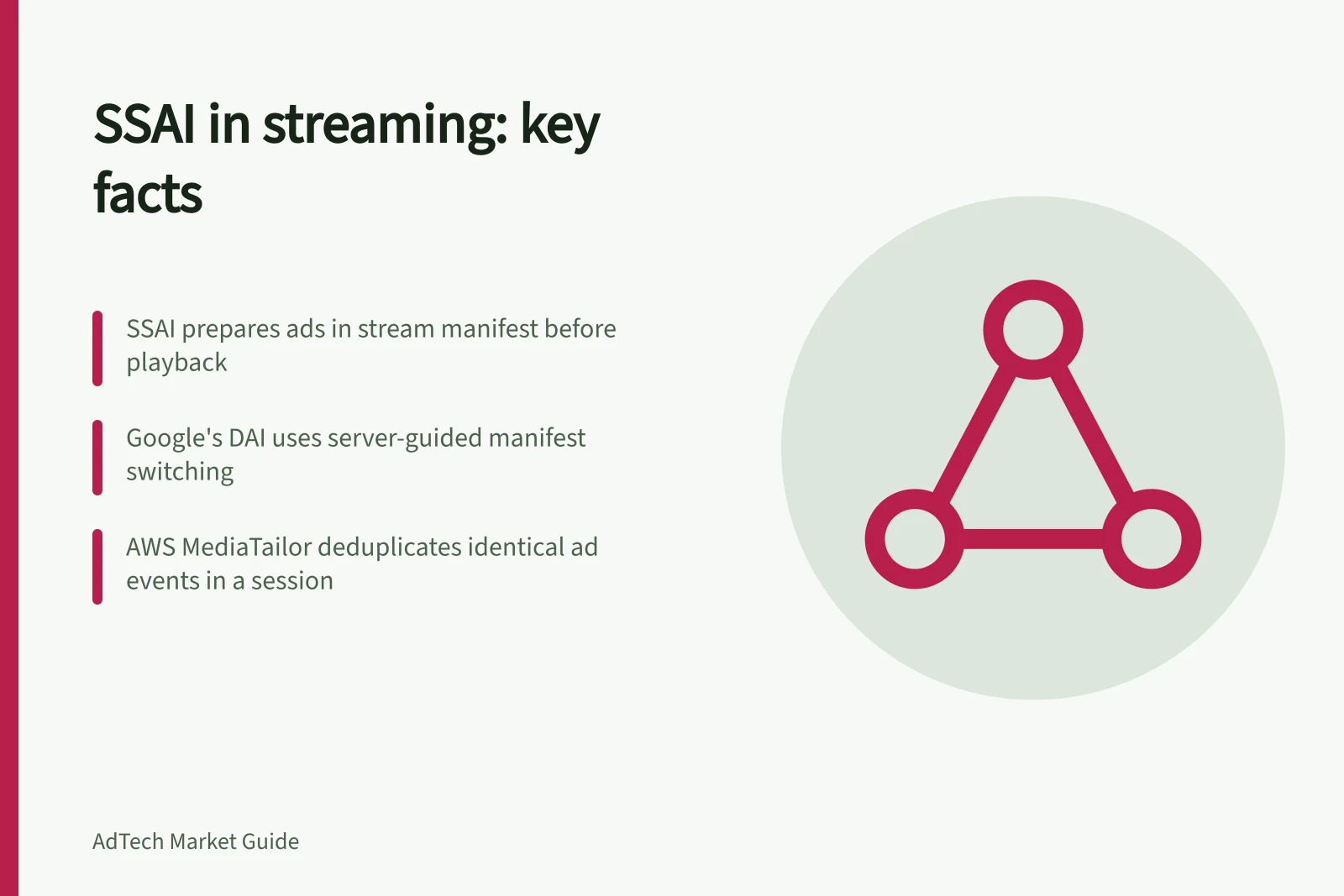
Google documents a full-service design in which its servers insert ads into a supplied stream. Its server-guided design prepares an ad pod manifest while the client player switches to the pod. These illustrate different allocations of server and player work. A product labelled “DAI” or “SSAI” does not, by itself, tell you which system observes playback.
Ask the proposed provider to identify the manifest owner, media preparation, player responsibilities and supported devices. Check the exact account and player integration before relying on a documented feature.
Interpret tracking carefully
AWS MediaTailor documents server-side reporting, where beacons are based on player segment requests, and client-side reporting, where the player sends them. Google’s full-service DAI documentation describes impression and tracking pings from its SDK or player app. A segment-request-based beacon does not directly establish the player’s rendered state, although a measurement method may validate server-originated signals using additional controls.
For an Australian deployment, request an event timeline for a normal ad, an abandoned break and a repeated segment request. Ask which records identify the viewing session and how repeated beacons are handled. MediaTailor documents deduplication for identical ad events within a viewing session; that product behaviour does not establish how another stitcher handles beacons or how upstream bid requests are handled.
Check the proposed implementation
With an authorised test stream, compare the break marker, ad response, manifest, segment requests, player events and beacons for a filled and an unfilled break. Check duration and fallback behaviour on each required player family. Keep counts named by their stage. If a buyer requires viewability or invalid-traffic evidence, ask the measurement partner which client signals it receives and which delivery remains unmeasured.