Verification
Part of Ad verification technology
Reviewing brand-suitability classifications
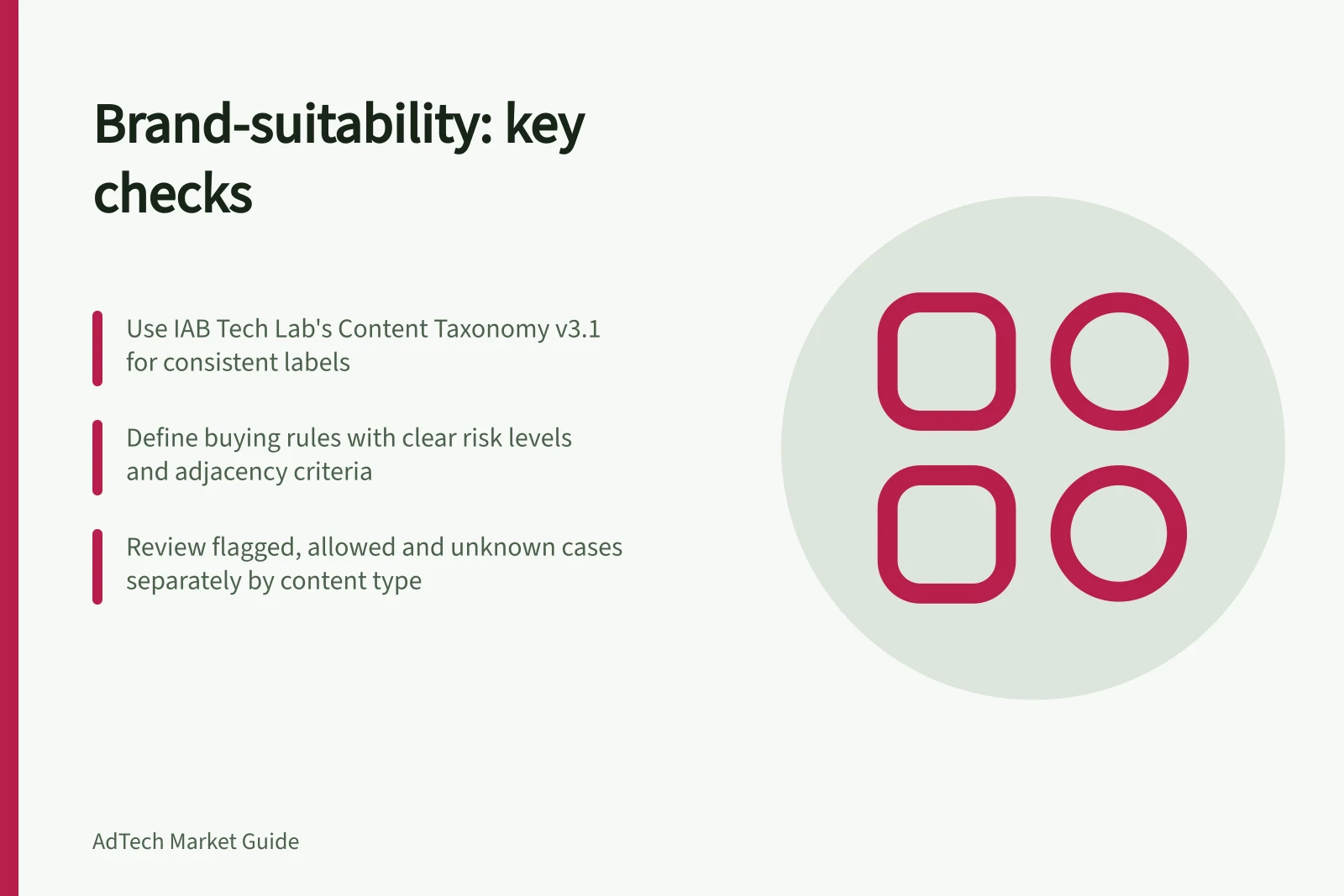
Review content labels, taxonomy versions, adjacency and unknown cases before turning brand-suitability classifications into buying rules.
A brand-suitability classification is useful when you know what content was classified, under which taxonomy and how the advertiser’s policy treats the label. Review the content description separately from the decision to allow, flag or avoid a placement. The same category name can otherwise hide different thresholds and evidence.
Separate the label from the rule
A taxonomy gives teams a shared vocabulary for content. IAB Tech Lab’s Content Taxonomy supports contextual targeting and brand safety, and its versions have changed. The IAB Tech Lab site lists version 3.1 and a mapping tool for older 2.x categories.
A broad subject label does not decide whether a particular advertiser should appear beside a particular item. Providers may use proprietary categories too. Ask which version is used and how any proprietary labels map to it.
Write the buying rule in plain language. Specify the content topic, the level of risk the brand accepts, the relationship to the ad that matters and the action to take. Keep the rule narrow enough that an analyst can explain an exception.
Excluding a broad topic can remove suitable inventory along with unsuitable inventory.
For example, a fictional Australian tourism advertiser might avoid placements directly beside graphic disaster footage but allow factual reporting about recovery. This illustrates a possible policy choice, not a rule for tourism brands. A system that cannot distinguish the cases at the required level should report that limit.
IAB Tech Lab Content Taxonomy Version Comparison
- Version
- 3.1
- Previous Version
- 2.x
- Mapping Tool Available
- Yes
Ask what the system could inspect
A site or app-level label is not a classification of a particular page, post, video segment or item beside an ad. When direct inspection is unavailable, a provider may rely on publisher data, a broader classification or an unknown result. Ask what supported the label and whether the content could have changed since classification.
Define adjacency as well. Is the content in the same item, directly beside the ad, elsewhere in a feed or in a nearby video in a playlist? Where a provider offers adjacency measurement, ask what measurement unit is used and how it is defined.
Ranges or scores may be reported when clearly defined. A suitability report should identify the assessed content unit, its relationship to the ad and any material measurement limit.
Steps to Evaluate Brand-Suitability Classifications
- Identify the taxonomy version usedCheck IAB Tech Lab site for current version (3.1) and mapping tools for 2.x
- Determine what the system inspectedAssess if classification is page-level, item-level or based on publisher data
- Define adjacency measurement unitClarify if content is in same item, directly beside ad, or nearby in feed/playlist
- Verify content stability since classificationConfirm whether content has changed post-classification
- Report measurement limits clearlyInclude assessed content unit, relationship to ad, and any material constraints
Review disputed and unknown cases
Sample both flagged and allowed placements across the formats bought. Include changing stories, user-generated comments and long videos, where a broad label may miss a relevant part.
Preserve the content and rule version available when the decision was made; a later page edit can change what a reviewer sees. Send ambiguous cases to the person responsible for the advertiser’s policy.
Track classified and allowed, classified and restricted, and not classifiable at the required level separately. Unknown is neither automatically safe nor automatically unsafe. Decide how the campaign treats it before buying.
Review possible false positives with the publisher or provider so a rule can be corrected without silently weakening the policy.